

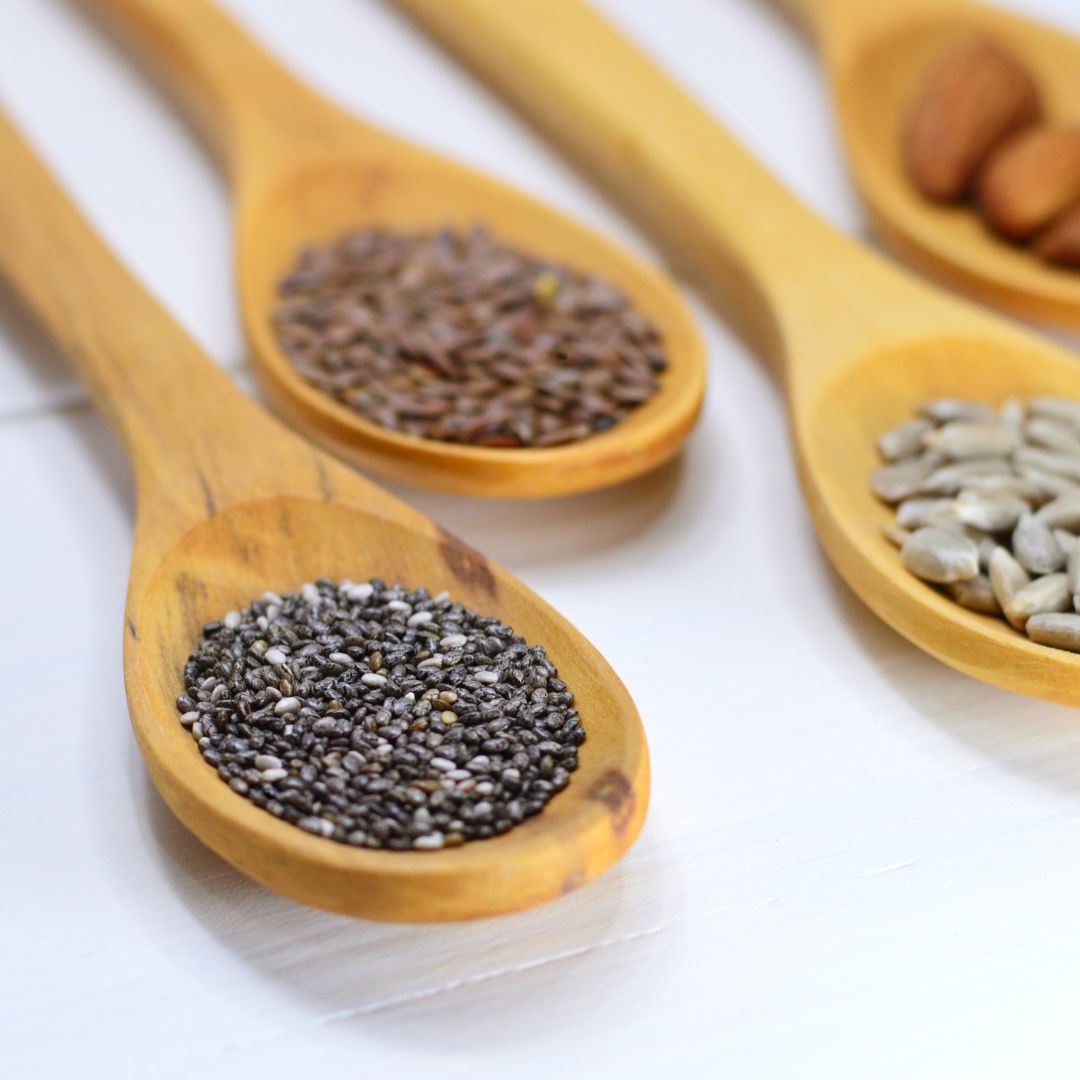
Seeds and nuts have been a fundamental part of the human diet for thousands of years. Beyond their energy value, they stand out for their high nutrient density and their ability to modulate key bodily functions such as digestion, metabolism, and hormonal balance.
Chia seeds (Salvia hispanica) and flax or linseed (Linum usitatissimum) are clear examples of how a small food can help us meet our nutritional requirements in a simple way, while also providing additional physiological benefits.
1. Their Composition: Beyond Fiber
A1. Nutritional Profile: Chia Seeds
High total fiber content (≈34 g/100 g)
Rich in soluble fiber, responsible for its gel-forming capacity
Plant-based source of omega-3 (ALA)
Significant amounts of calcium, magnesium, phosphorus, iron, and zinc
Polyphenols with antioxidant activity
A2. Nutritional Profile: Flax Seeds
One of the richest dietary sources of omega-3 (ALA).
Balanced proportion of soluble and insoluble fiber.
Lignans, phytochemicals with hormone-modulating activity.
B vitamins and minerals such as magnesium and potassium.
B. Fiber, Microbiota, and Gut Health: The Central Axis
The main nutritional interest of chia and flax lies in their fiber, particularly soluble fiber.
This fiber acts as a fermentable substrate for the gut microbiota, promoting the production of short-chain fatty acids (SCFAs), such as butyrate, which have anti-inflammatory effects.
SCFAs contribute to the integrity of the intestinal barrier, regulate inflammation, and participate in glucose and lipid metabolism.
C. Mucilage: Regulating Bowel Transit and Protecting the Stomach
Both chia and flax contain mucilage, a type of soluble fiber capable of absorbing water and forming a viscous gel. This gel performs several relevant physiological functions:
At the Intestinal Level
Increases stool bulk and improves bowel transit.
Softens stools, facilitating evacuation.
Slows the absorption of glucose and fats.
Contributes to greater satiety.
At the Digestive Mucosa Level
Coats the gastric and intestinal lining.
Reduces digestive irritation.
Promotes epithelial regeneration.
Acts as a natural gastric protector in mild conditions. protector gástrico natural en procesos leves.
This effect may be particularly interesting in cases of mild gastritis or functional dyspepsia; occasional heartburn; low-grade digestive inflammation; and irritable bowel syndrome with constipation.
D. Lignans and Hormonal Balance
Flax contains a high concentration of lignans, compounds that colon bacteria convert into metabolites called enterodiol and enterolactone. These metabolites have a structure similar to estrogen, but with much weaker activity. For this reason, they may modulate estrogenic action by binding to estrogen receptors and exerting a milder effect. This could help reduce the effects of excess circulating estrogen, a factor associated with the development of endometriosis, uterine fibroids, polycystic ovary syndrome (PCOS), and premenstrual syndrome.Although studies in women are limited, in vitro research and animal models suggest that flax may exert modulatory effects on estrogen metabolism, potentially improving fertility and reducing associated symptoms.
On the other hand, during menopause there is a marked decline in estrogen and progesterone levels, leading to typical symptoms such as hot flashes, mood changes, and reduced quality of life. In this context, flax may be helpful by partially activating estrogen receptors, potentially attenuating some menopausal symptoms. Clinical trials in peri- and postmenopausal women have observed that regular consumption of flax or lignan-rich products (10 g/day) is associated with a reduction in the severity of menopausal symptoms and improvements in quality of life. However, results are not fully consistent across studies, and the effect is clearly more modest than hormone replacement therapy—though without its associated side effects.
The fact that the microbiota is required to convert these compounds into beneficial metabolites reinforces the idea that the effects of these seeds depend not only on the food itself, but also on each person’s microbiota status.
2. How to Prepare Them to Maximize Their Benefits
The way these seeds are consumed is crucial for them to be truly beneficial at a nutritional and physiological level. Whole seeds cannot be broken down by our digestive enzymes, and although they hydrate later in the intestine, there is not enough time for them to soften sufficiently and fully release their compounds and nutrients. For this reason, it is important either to hydrate them beforehand or to grind them and ensure adequate hydration.
- Ground: This improves the bioavailability of omega-3 and lignans. Do not consume them dry without adding a source of hydration afterward (at least one glass of water). If they don’t absorb enough water, they may cause digestive discomfort and constipation (by forming a blockage). Consuming them ground and hydrated can be especially helpful in cases of loose stools or diarrhea.
- Hydrated (whole or ground):Ideal for taking advantage of their mucilage and achieving a protective digestive effect. Chia seeds should be soaked in three times their volume of water, and flax seeds in twice their volume.
3. How to Store Them
Whole Seeds
Whole seeds can be stored in an airtight container (ideally glass) in a pantry for a long time—up to a year or even longer.
Ground Seeds
Once ground, seeds are exposed to oxygen, light, and heat, and sensitive components such as omega-3 degrade much faster, as do compounds like lignans. For this reason, ground seeds should be stored in an airtight container in the refrigerator for a maximum of 3–4 weeks. My recommendation is to grind them in batches every two weeks.
Hydrated Seeds
When seeds are hydrated, they become much more susceptible to microbial growth and fermentation, due to the presence of free water. In this case, they should be stored in an airtight container in the refrigerator for 3–5 days. Although refrigeration slows microbial growth, it is important to always smell the seeds before consuming them—the odor should be neutral. An unusual or unpleasant smell indicates bacterial fermentation, and they should be discarded.
4. When Can They Be Especially Useful?
Flax and chia seeds, along with other seeds and nuts, are sources of healthy fats with high nutrient density (minerals, vitamins, protein, and quality fats) suitable for the general population. They can help meet daily nutritional requirements, especially in individuals following more vegetarian-based diets.
However, certain groups may benefit particularly, including people with:
- Constipation:Taking 1 tablespoon of pre-soaked seeds before main meals improves bowel transit and stool consistency, helping resolve chronic constipation.
- Insulin resistance:A very common condition in polycystic ovary syndrome (PCOS), obesity, and metabolic syndrome. Acting like sponges, they help absorb glucose and cholesterol, and their fiber and fats slow gastric emptying, reducing glycemic spikes, improving insulin sensitivity, and increasing satiety.
- Hypercholesterolemia:When taken with main meals, their fiber helps reduce total dietary cholesterol absorption, lowering total blood cholesterol and LDL cholesterol (which can be harmful to cardiovascular health in excess, especially when HDL is low).
- PCOS with an androgenic profile (common in women without overweight or obesity): Although human evidence is limited, animal models suggest that flax, thanks to its lignans, may improve fertility and hormonal balance.



 English
  Spanish
  French